
Why did I write this article on ECOWAS explained? That’s simple. Have you ever seen the letters “ECOWAS” in a headline and quietly hoped nobody would quiz you on what it means? You’re in good company. ECOWAS stands for the Economic Community of West African States. Think of it as West Africa’s regional neighborhood association, except instead of arguing over fence heights, its members coordinate trade, travel, security, and, increasingly, cybersecurity across an entire region. This article breaks ECOWAS down in plain English: what it is, when it started, where it’s based, and why its cybersecurity work matters, even if you’ve never set foot in West Africa.
Table of Contents
Table of Contents…………………………………………………………………………………………. 1
What Is ECOWAS, in One Sentence?……………………………………………………………….. 1
When Was ECOWAS Established?………………………………………………………………….. 1
Where Is ECOWAS Headquartered?……………………………………………………………….. 1
What Is ECOWAS’s Purpose?…………………………………………………………………………. 1
Which Countries Belong to ECOWAS?…………………………………………………………….. 1
What Does ECOWAS Do About Cybersecurity?………………………………………………… 1
Why Does ECOWAS’s Cybersecurity Work Matter to You?………………………………… 1
Frequently Asked Questions………………………………………………………………………….. 1
Further Reading…………………………………………………………………………………………… 1
What Is ECOWAS, in One Sentence?
Quick Answer: ECOWAS (Economic Community of West African States) is a regional organization of West African countries, founded in 1975 to promote trade and economic cooperation. Headquartered in Abuja, Nigeria, it also coordinates regional security, including a growing cybersecurity program that helps member countries fight cybercrime and protect critical digital infrastructure.
That’s ECOWAS explained in two sentences. Now let’s unpack it piece by piece.
ECOWAS Explained: When Was ECOWAS Established?
ECOWAS was created on May 28, 1975, when representatives from fifteen West African countries signed the Treaty of Lagos in Lagos, Nigeria. That makes ECOWAS a 1970s institution, born in the same decade as disco and the Rubik’s Cube — and, like both of those, it has had to adapt more than once to stay relevant.
A few key milestones since then:
- 1975: Treaty of Lagos signed; ECOWAS officially founded.
- 1977: Cape Verde joins, bringing early membership to fifteen countries.
- 1993: The founding treaty is revised to strengthen the organization’s economic and political goals.
- 2000: Mauritania withdraws its membership.
- 2025: Mali, Burkina Faso, and Niger formally withdraw from ECOWAS (more on that below).
ECOWAS Explained: Where Is ECOWAS Headquartered?
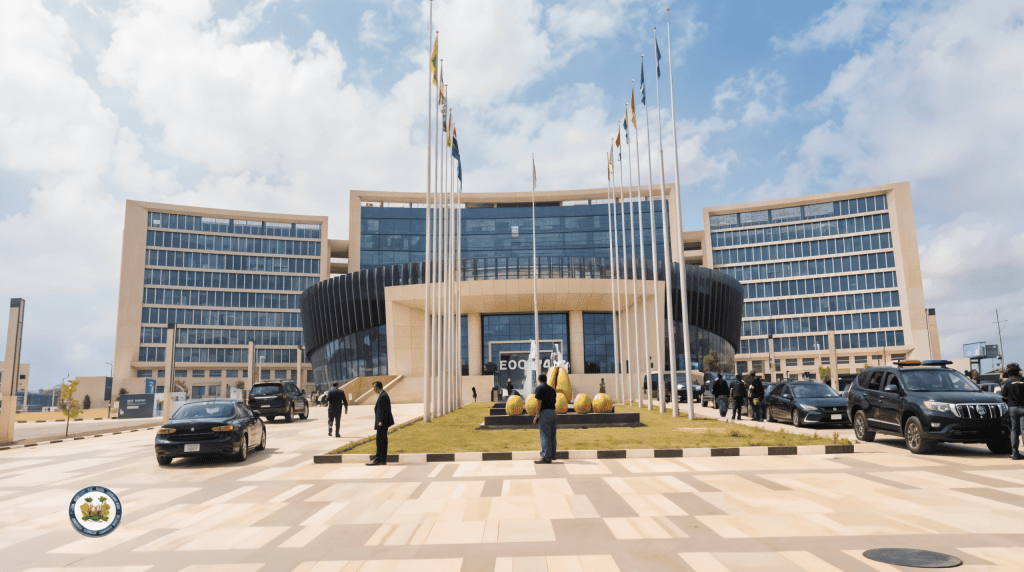
ECOWAS is headquartered in Abuja, Nigeria. Nigeria is the largest economy in the ECOWAS bloc, so hosting the headquarters there is a bit like a company setting up its main office in whichever city already has the most employees, the most infrastructure, and the best airport connections.
The organization operates in three official languages: English, French, and Portuguese. This reflects the mix of former British, French, and Portuguese colonies that make up the region.
ECOWAS Explained: What Is ECOWAS’s Purpose?
ECOWAS exists to help West African countries do more together than they could do alone. Picture 12-15 small shops on the same street deciding to share a delivery truck, a security guard, and a set of common rules. Suddenly everyone’s costs go down, and everyone’s leverage goes up. That’s ECOWAS, at a regional scale.
Its core goals include:
- Promoting free trade and the free movement of people, goods, and services between member countries.
- Harmonizing economic, agricultural, and industrial policy across the region.
- Maintaining peace and security, including through the ECOWAS Standby Force, a regional peacekeeping arm.
- Advancing infrastructure projects such as regional roads, power grids, and telecommunications.
- Strengthening digital cooperation, including cybersecurity and cybercrime policy.
ECOWAS Explained: Which Countries Belong to ECOWAS?
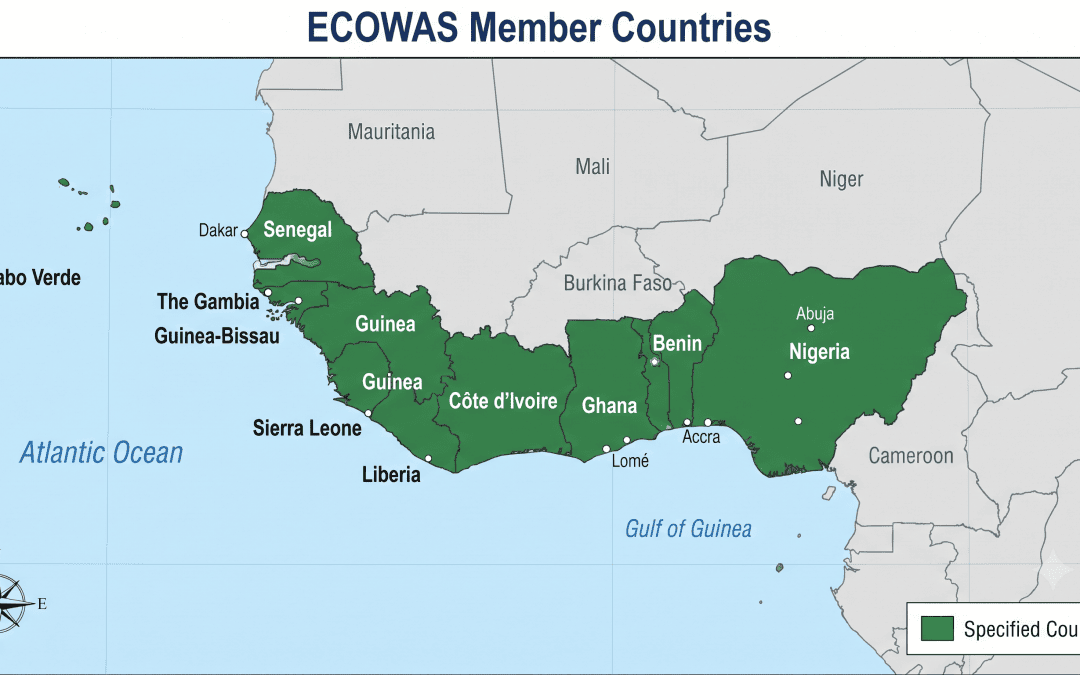
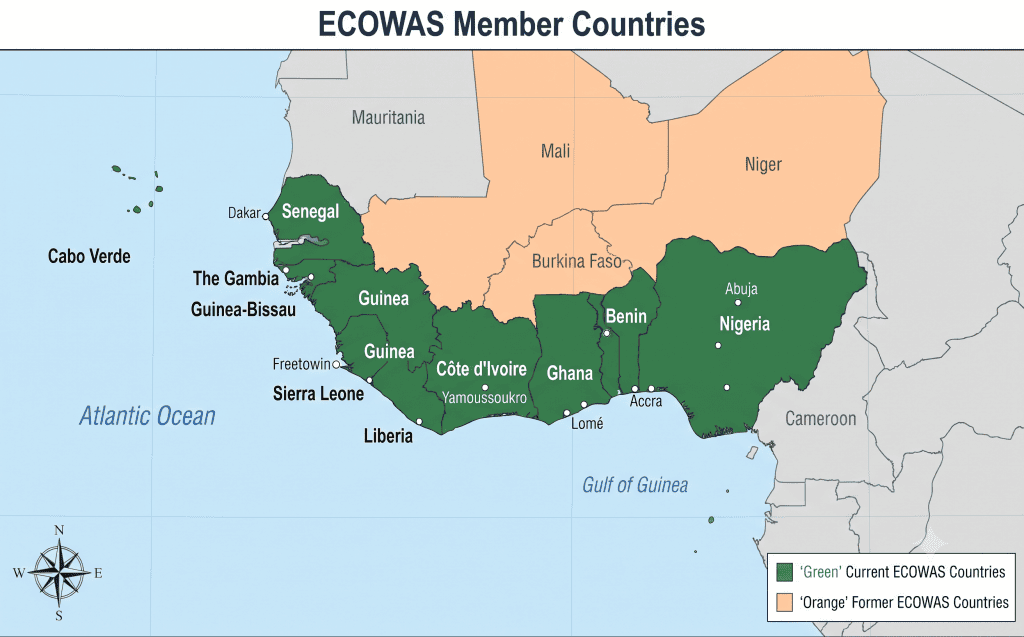
ECOWAS was founded with fifteen member states. As of early 2025, that number dropped to twelve after Mali, Burkina Faso, and Niger formally withdrew to form their own bloc, the Alliance of Sahel States (AES). The current ECOWAS member countries are:
- Benin
- Cabo Verde
- Côte d’Ivoire
- The Gambia
- Ghana
- Guinea
- Guinea-Bissau
- Liberia
- Nigeria
- Senegal
- Sierra Leone
- Togo
ECOWAS has said it is keeping the door open if the three departed countries ever want to rejoin. This is more of a “see you later” than a permanent goodbye.
ECOWAS Explained: What Does ECOWAS Do About Cybersecurity?
This is the part most beginner-friendly explainers skip, and it’s the reason this article exists. ECOWAS doesn’t just deal with trade routes and border crossings. It also works to protect the region’s digital infrastructure, and that effort has been building for over a decade.
Here’s the timeline, in plain terms:
- 2011 – Cybercrime Directive: ECOWAS adopted a directive requiring member states to update their criminal laws so cybercrime could actually be prosecuted, not just described in a report somewhere.
- 2021 – Regional Cybersecurity and Cybercrime Strategy: A region-wide plan pushing member states to adopt national cybersecurity strategies, set up dedicated cybersecurity authorities, and protect critical infrastructure like power grids and financial systems.
- National CIRT/CERT Program: ECOWAS helps countries build and test Computer Incident Response Teams, essentially the region’s digital fire departments, through assessments and regional cyberdrills.
- OCWAR-C Project: An EU-funded initiative that strengthens the resilience of information infrastructure and builds the skills of the people who investigate cybercrime.
- Regional Hackathons: Youth-focused competitions across member states designed to identify and grow cybersecurity talent in the region.
- Child Online Protection Initiative: A collaborative effort to promote safer internet use for children and young people.
- 2025-Revised Cybercrime Directive and Cyber Diplomacy Training. ECOWAS updated its cybercrime rules for a more complex digital landscape and became the first regional bloc in Africa to build cyber diplomacy training into its foreign service education.
In short: ECOWAS treats cybersecurity the same way it treats trade or peacekeeping. It is something no single country can handle alone, so the region tackles it together.
ECOWAS Explained: Why Does ECOWAS’s Cybersecurity Work Matter to You?
Even if you’ve never been to West Africa, this work has ripple effects worth understanding:
- Global cybercrime is borderless. Weak cybersecurity anywhere can become a launchpad for attacks that reach businesses and individuals worldwide. Under-resourced regions are particularly vulnerable.
- Shared standards make cross-border business safer. As more companies operate across West African markets, harmonized cybercrime laws and incident response make it easier to trust the digital infrastructure they rely on.
- It’s a model for regional cooperation. Other regional blocs studying cybersecurity governance often look at ECOWAS’s approach as a case study in what regional collaboration can accomplish.
If your work touches West African markets, digital policy, or regional security, ECOWAS is one of the organizations worth keeping on your radar.
Frequently Asked Questions
What does ECOWAS stand for?
ECOWAS stands for the Economic Community of West African States.
When was ECOWAS founded?
ECOWAS was founded on May 28, 1975, through the Treaty of Lagos.
Where is ECOWAS headquartered?
ECOWAS is headquartered in Abuja, Nigeria.
How many countries are currently in ECOWAS?
As of early 2025, ECOWAS has twelve member states, after Mali, Burkina Faso, and Niger withdrew to form the Alliance of Sahel States.
Does ECOWAS have a cybersecurity strategy?
Yes. ECOWAS adopted a Regional Cybersecurity and Cybercrime Strategy in 2021, building on a 2011 Cybercrime Directive that it revised again in 2025.
Is ECOWAS the same as the African Union?
No. The African Union (AU) represents the entire African continent, while ECOWAS is a regional economic community focused specifically on West Africa. ECOWAS is one of several regional blocs that work under the AU’s broader framework.
About the Author
 Namoneh Kandeh | Namoneh Kandeh is a cybersecurity law and policy professional and CEO of Continental Cybersecurity Solutions for Critical Infrastructure Inc. (CCSCI). She holds a Master of Science in Law (MSL) in Cybersecurity Law from the University of Maryland, Baltimore. She serves as a NICE/NIST Cybersecurity Career Ambassador, promoting cyber awareness and critical infrastructure protection. Her work bridges cybersecurity and human rights, spanning digital forensics, counter-terrorism, and data privacy; alongside service as a Chief Judge in the 2024 U.S. Presidential Election in Montgomery County, Maryland, and a youth-rehabilitation initiative she founded in Sierra Leone.
Further Reading
Economic Community of West African States. (2025, January 29). Burkina Faso, Mali and Niger’s withdrawal from ECOWAS is now a reality. ECOWAS. https://www.ecowas.int/burkina-faso-mali-and-nigers-withdrawal-from-ecowas-is-now-a-reality/
Encyclopedia Britannica. (2026, April 27). Economic Community of West African States. https://www.britannica.com/topic/Economic-Community-of-West-African-States
DiploFoundation. (2023, December 12). ECOWAS Regional Cybersecurity and Cybercrime Strategy. Digital Watch Observatory. https://dig.watch/resource/ecowas-regional-cybersecurity-and-cybercrime-strategy
ECOWAS Cyberportal. (n.d.). Reflecting on 2025: ECOWAS achievements in advancing regional cyber resilience. https://cyberportal.ecowas.int/reflecting-on-2025-ecowas-achievements-in-advancing-regional-cyber-resilience/
ECOWAS Parliament. (2021, January 25). ECOWAS adopts a regional strategy for cybersecurity and the fight against cybercrime. https://www.parl.ecowas.int/information-and-communication-technology-ecowas-adopts-a-regional-strategy-for-cybersecurity-and-the-fight-against-cybercrime/